


3/12/24 – 5/12/24
After a quick change of trains in Miskolc, on the Hungarian border, we were on our way to Budapest. The last time I visited the Hungarian capital was almost 20 years ago, as a young child, and so I had but a few short memories of the place to go off. We pulled into Budapest Keleti Station, a grand old building from which most international trains depart and arrive from in Budapest – the other major station Nyugati, was about a 45 minute walk away, and directly opposite our accommodation in Budapest (T62 Hotel).

Budapest Keleti Station
By the time we had checked in and dropped off our bags, it was starting to get dark, and so we decided to head to St Stephens Basilica, where Budapest’s award-winning Christmas markets were held. The church is beautiful, especially when lit up at night, but the prices at the markets were horrifying – even by Christmas market standards! They were charging upwards of €16 for a sausage in a bun, and €10 for a small cup of hot wine, which was about 4/5x the price of things at Kosice’s market just the previous night.


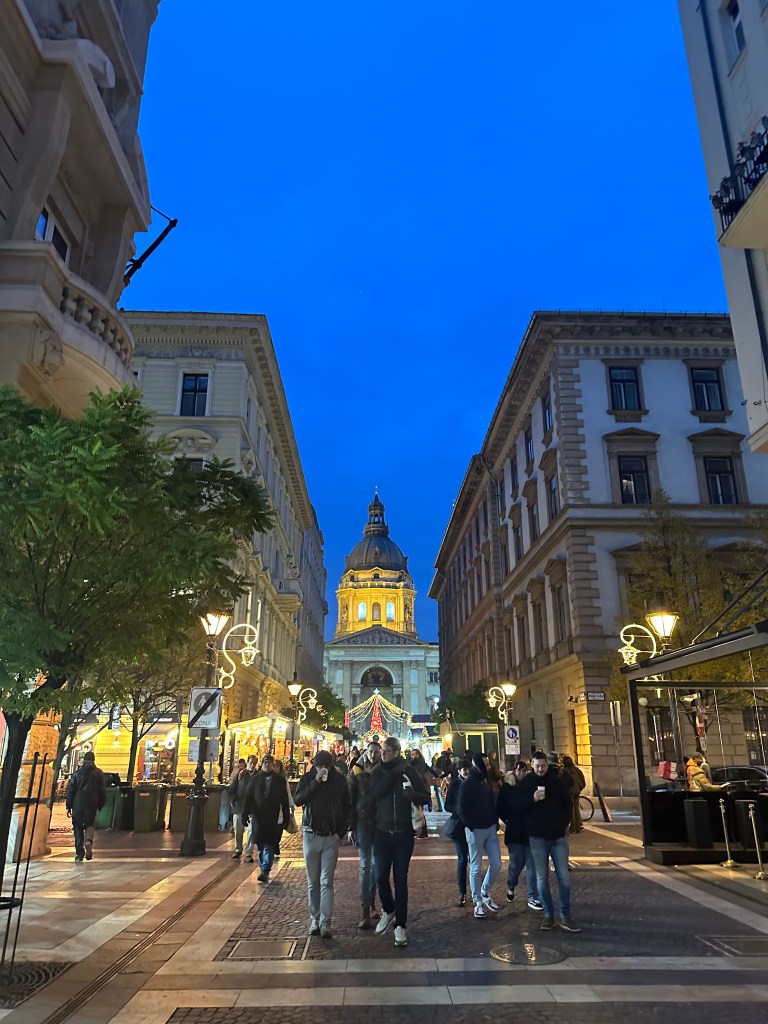
St Stephen’s Basilica in the evening
We continued over to the banks of the Danube, walking down the riverside and taking in the views – Budapest is one of those cities that gets beautifully illuminated at night time!


Some views of Budapest at night
The next morning, after a filling breakfast, we headed out to explore some of Budapest’s most iconic buildings, including the Parliament, the Chain Bridge, and over the other side of the Danube, Fisherman’s Bastion.
Budapest’s Parliament building is possibly one of the most striking buildings in Europe – instantly recognisable, absolutely enormous, and very iconic, it is one of Hungary’s most-visited sites. Today, however, it was deserted, which meant we were able to wander around the exterior completely unhindered by crowds.

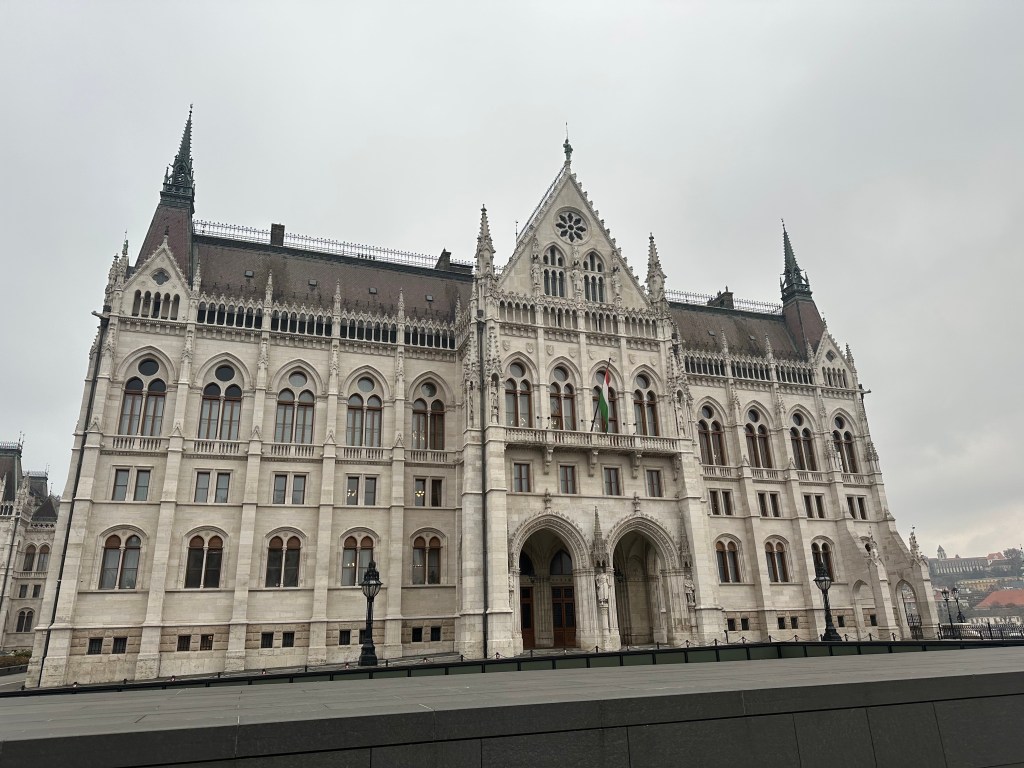
The Hungarian Parliament Buildings in Budapest
Along the Danube, next to the Parliament buildings, is the ‘Shoes on the Danube Bank’ memorial, an art installation that serves as a harrowing reminder of the massacres that occurred in Budapest during World War Two, where fascist Hungarian militias shot Jews on the banks of the river, so that they’d fall directly into the water – their shoes were left behind as valuables that could be sold. Unlike the Parliament buildings, there were quite a few people gathered around the memorial – in fact, the closer we got to the other side of the rive, the busier it became.

The ‘Shoes on the Danube Bank’ memorial in Budapest
We continued on down the Danube until we reached the Chain Bridge, where we crossed the river. As I’m sure many people know, Budapest was once three seperate cities: Buda; Obuda; and Pest. Buda and Pest were the most well known, with Buda on the western side of the Danube, and Pest on the east. In 1873, they unified, and the city became known as ‘Budapest’ – but there are still many differences between the two, including the terrain (hillier in Buda, flatter in Pest), and character. We were staying on the Pest side of the Danube, and so as we crossed the bridge, we found ourselves in Buda. This side of the Danube is home to several key Budapest landmarks, including the Buda Castle, Gellert Hill, and Fisherman’s Bastion.
After walking over, we continued up a staircase (rather than take the funicular), to get a view out over the bridge.
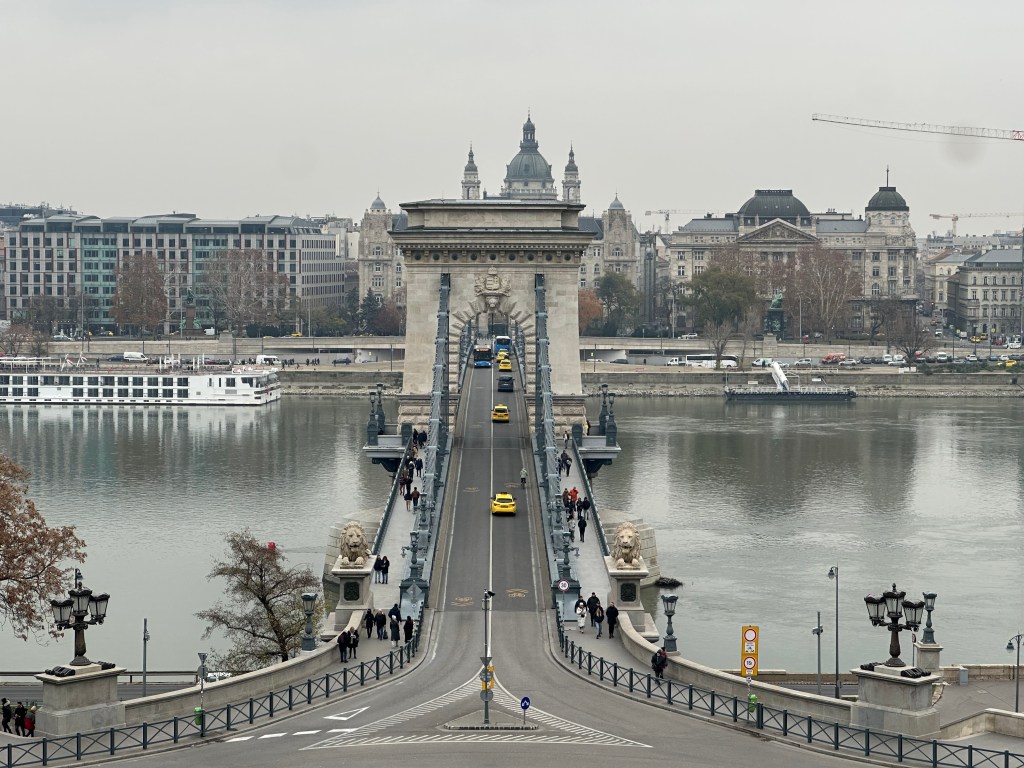
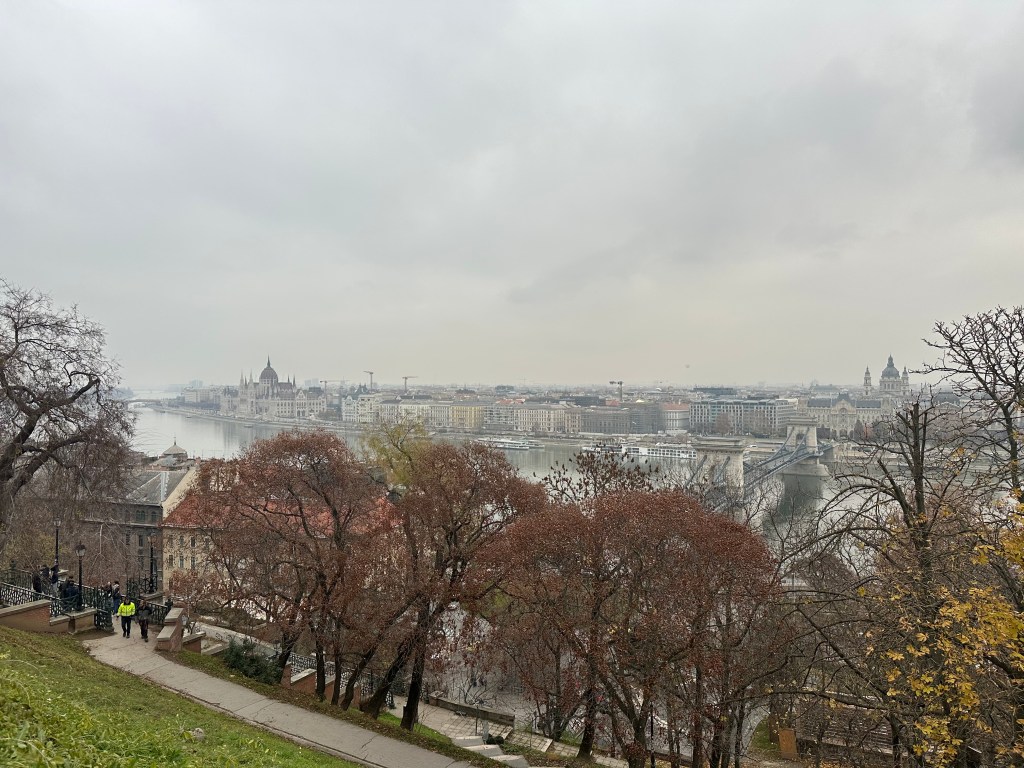
View from the top of the hill overlooking the Chain Bridge
At the top of the hill is Sandor Palace, the home of the Hungarian President. We actually got to the entrance just as the troops outside were beginning their changing of the guard ceremony, which was fascinating to watch.

The guards outside Sandor Palace
Our next stop in Buda was Fisherman’s Bastion, and the Church of Our Lady of Buda. I actually have some vague memories of Fisherman’s Bastion, from many years ago – it was interesting to go back and see it again! There was another Christmas market perched next to the church, and the place was packed with tourists, something that we hadn’t yet experienced on this trip yet.

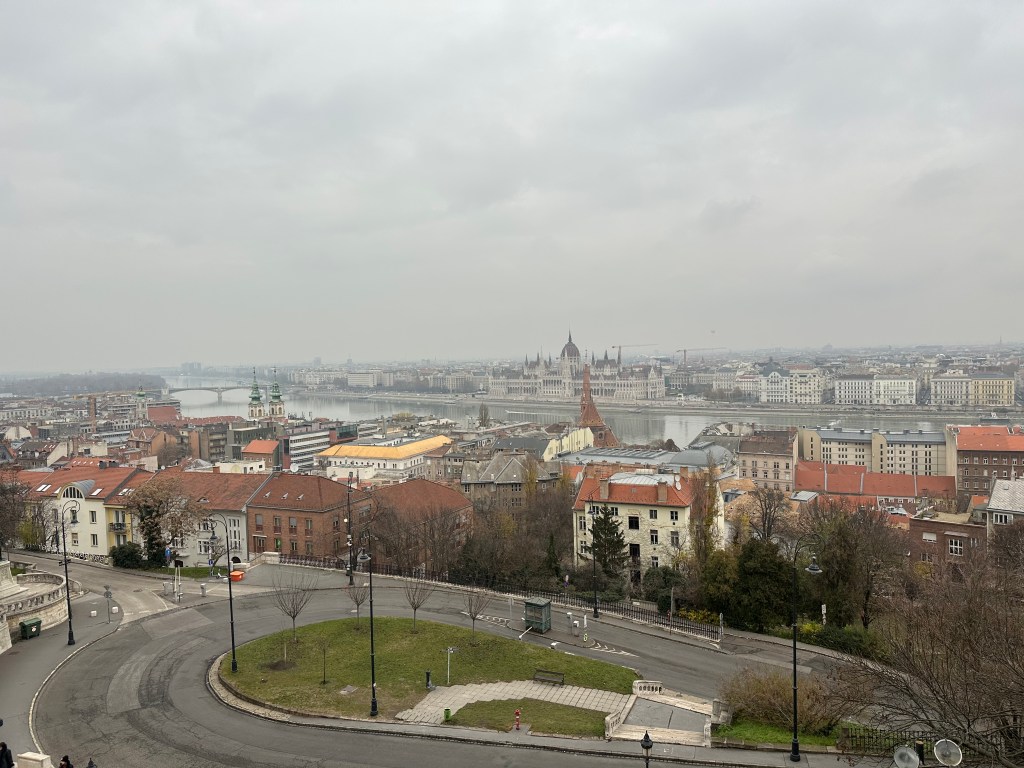

Fisherman’s Bastion steps, the view over the Danube, and the Church of Our Lady of Buda
We made out way down the hill to the banks of the river, and continued our walk north, stopping along the way to spot the miniature sculptures and artworks that dotted the fence-line – products of Ukrainian-Hungarian artist Mihaly Kolodko, a sculptor who has made a great number of ‘mini-statues’ since 2010.
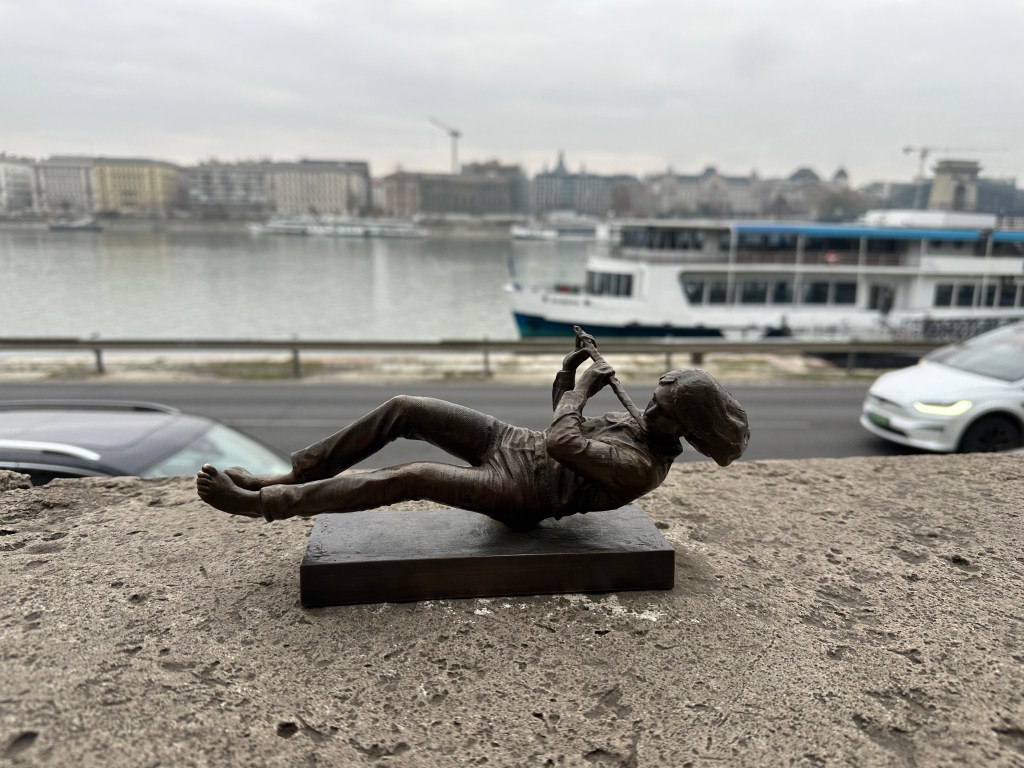

Some of Mihaly Kolodko’s miniature statues
Just north of the Chain Bridge is an island that splits the Danube – Margaret Island – a huge piece of green space in the middle of the busy city. We walked the 2.5km length of the island, taking in a little bit of well-deserved piece and quiet!

Greenery on Margaret Island
We took a long loop back into the city centre, taking in the strange sights of the Danube, ranging from the ubiquitous river cruises to a truck/boat hybrid taking people on a sightseeing tour of the northern reaches of Budapest. We ended up not far away from St Stephen’s Basilica, at a memorial to the Soviet Army, which liberated Budapest from fascists at the end of World War 2. What is strange about this particular monument, complete with gleaming hammer and sickle, is that it sits in a courtyard directly opposite the (highly fortified) U.S. Embassy, and in a park with statues of George H.W. Bush, and Ronald Reagan. What odd bedfellows!
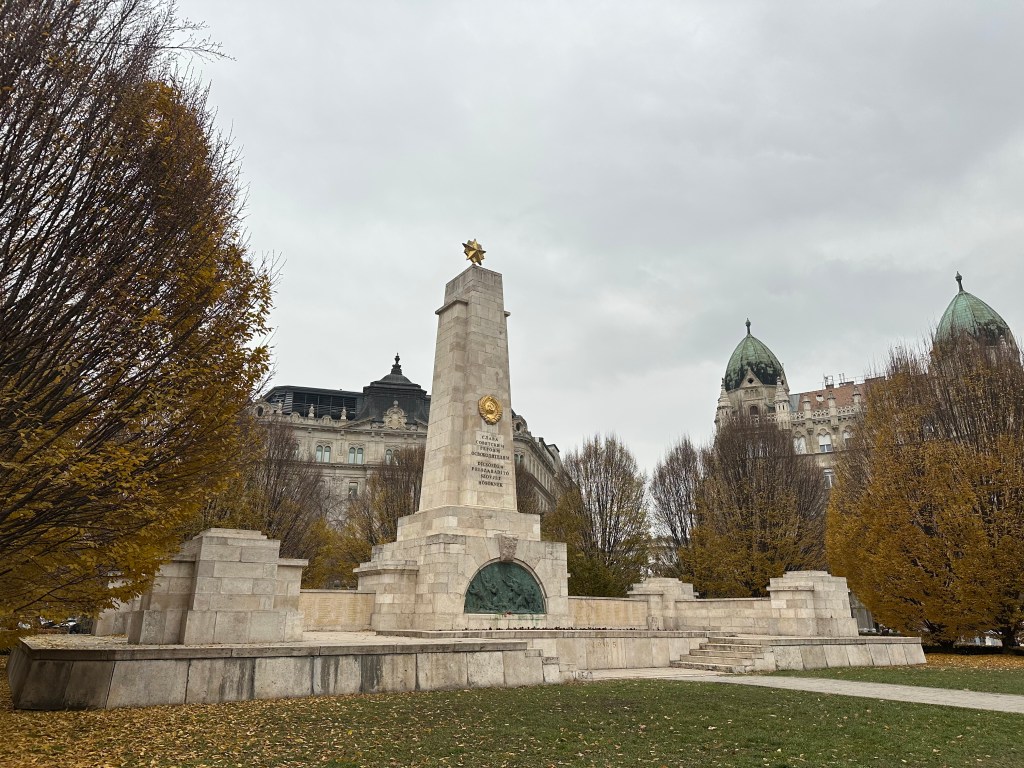

Soviet memorial in Budapest
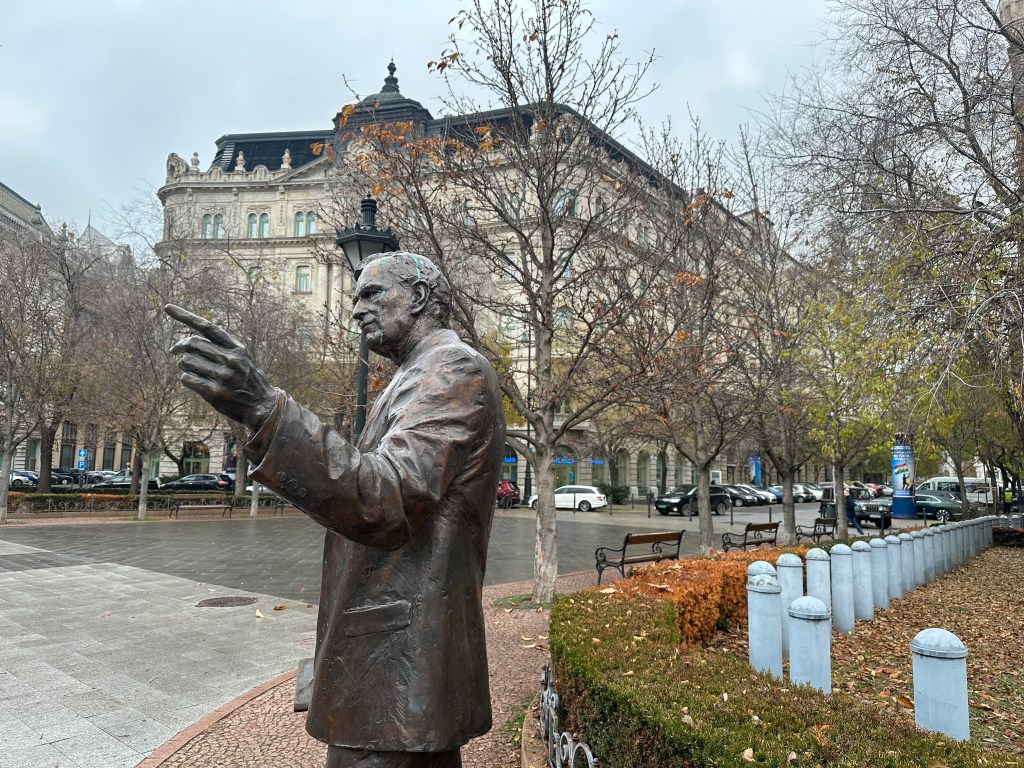

The statues of George Bush and Ronald Reagan, in the same park as the Soviet monument!
At the same park is a small protest site, set up in opposition to a new monument erected by the government of Hungary, which presents the Hungarian government as a victim of Nazi aggression in WW2. The protestors aren’t happy about this, as the fascists who took charge of Hungary were complicit in the Holocaust, and they view this as the current government shirking responsibility.
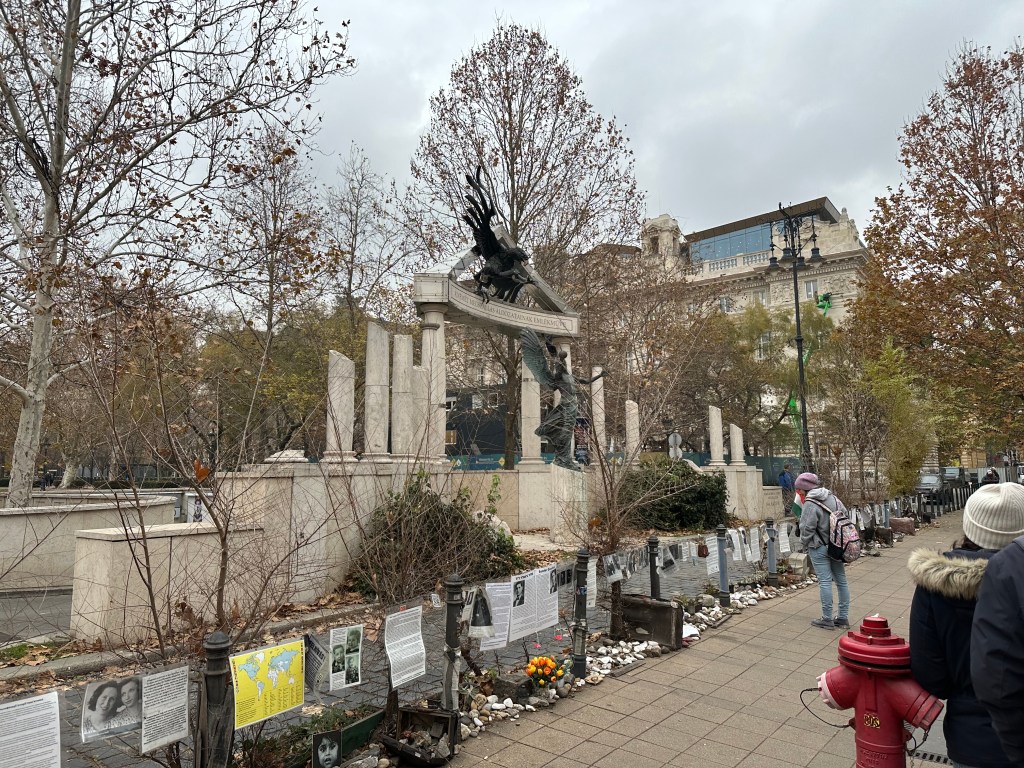
A quiet protest wall in front of a controversial new WW2 monument
That evening, we headed back over the Chain Bridge to capture that famous view of the brightly-illuminated Parliament buildings. It certainly is an impressive sight!

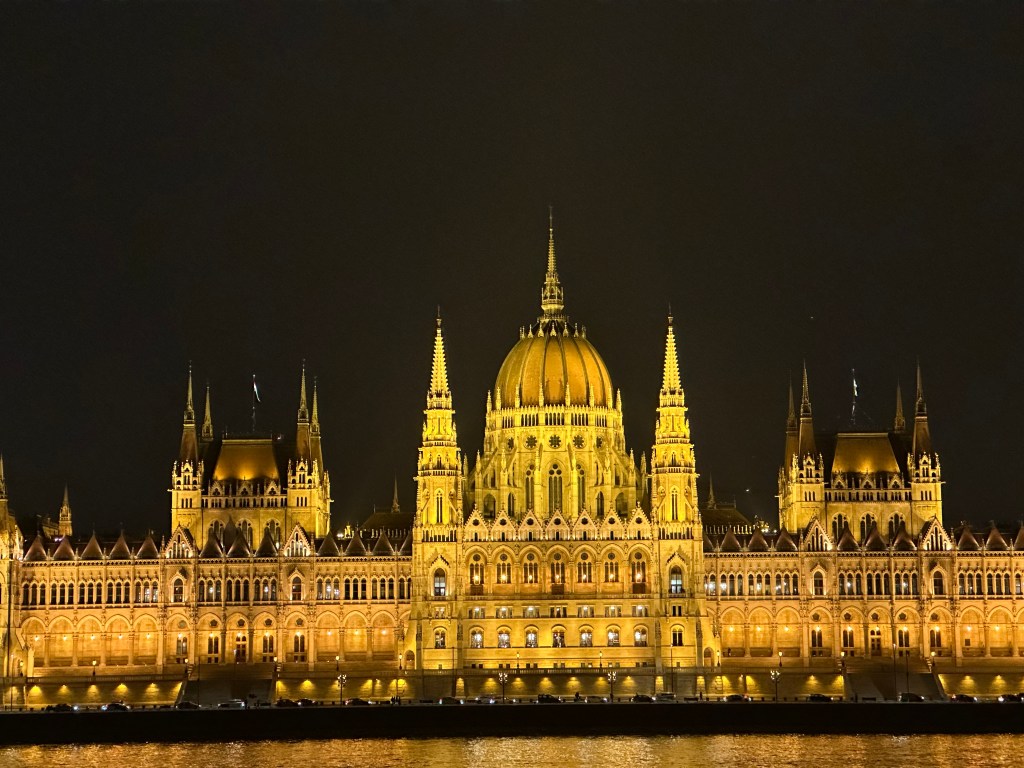
The Hungarian Parliament lit up at night
After walking back over the Chain Bridge, and across the front of the Parliament (checking out the enormous Christmas tree there – and the heavily-decorated tram!), we ended up that evening at a sports bar to watch the Liverpool match!

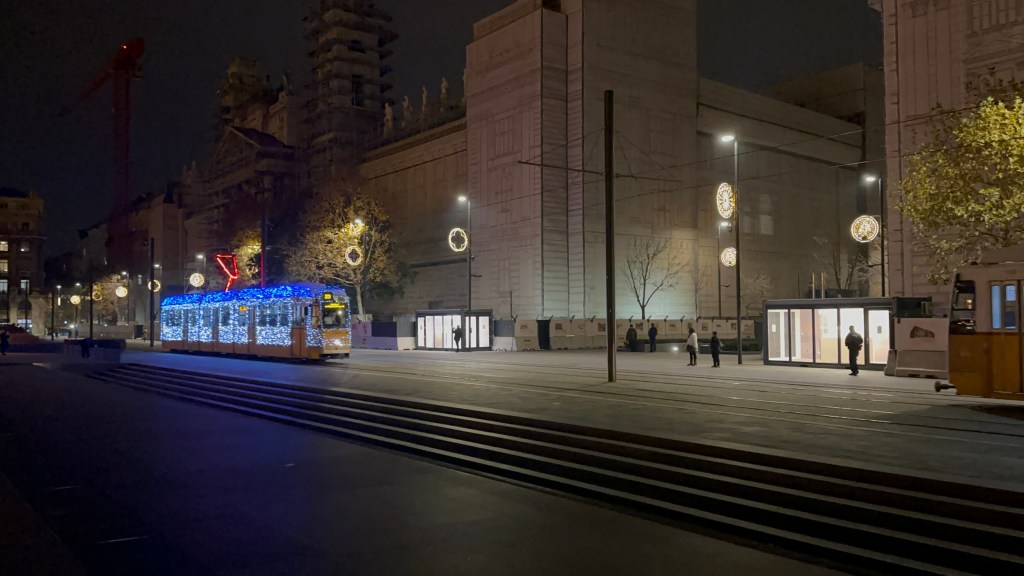
Christmas tree out the front of Parliament, and the Christmas tram
The next day was our last in Hungary, but we still had plenty of time – our overnight train to Brasov didn’t leave until the evening, which meant we were able to do a bit more exploration!
Our first port of call was the Hungarian State Opera, an incredible Baroque opera house. You’re actually able to go inside the reception area without a ticket – the ticket office is inside! – which meant that we were able to get a bit of a look at the beautiful interior.


The Hungarian State Opera House
Whilst we didn’t intend to visit the Szechenyi Baths, we did walk up in that direction, towards Heroes Square (another landmark I had some faint memories of!). Along the way, we stopped and checked out Budapest’s 130 year-old M1 metro line – a fascinating piece of engineering, in which a channel was first cut into the ground, the trackwork laid, and then the tunnel was covered over (eventually covered by one of Budapest’s major arterial roads!). It is quite strange standing in a tunnel just metres below traffic, as a metro train thunders past you!


The interior of a station on Budapest Metro’s M1 line, completed in 1896. Note the very low ceilings!
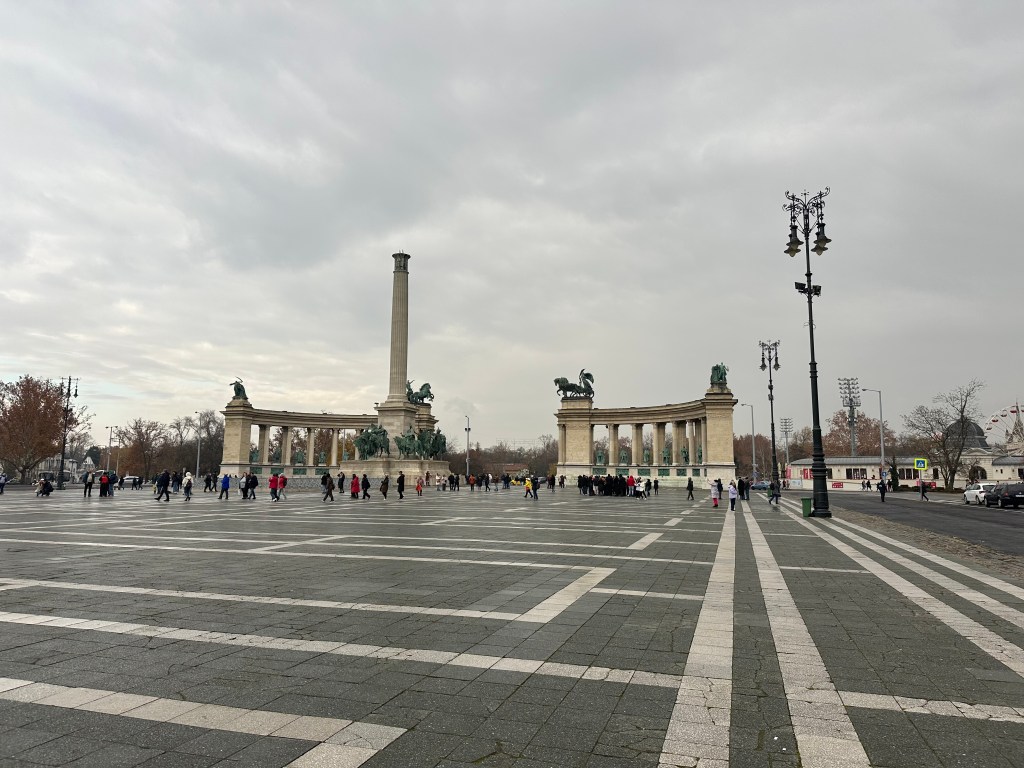
Heroes Square in Budapest
By Heroes Square, some Christmas markets were being set up at the entrance to Vajdahunyad Castle, as well as an enormous ice-skating rink (possibly one of the largest outdoor rinks I’ve ever seen!). Heroes Square, despite that photo, was actually quite packed with tour groups – we actually arrived just before the coach-loads of tourists.
We continued our wandering around Budapest, checking out some other interesting spots we had missed the previous day.

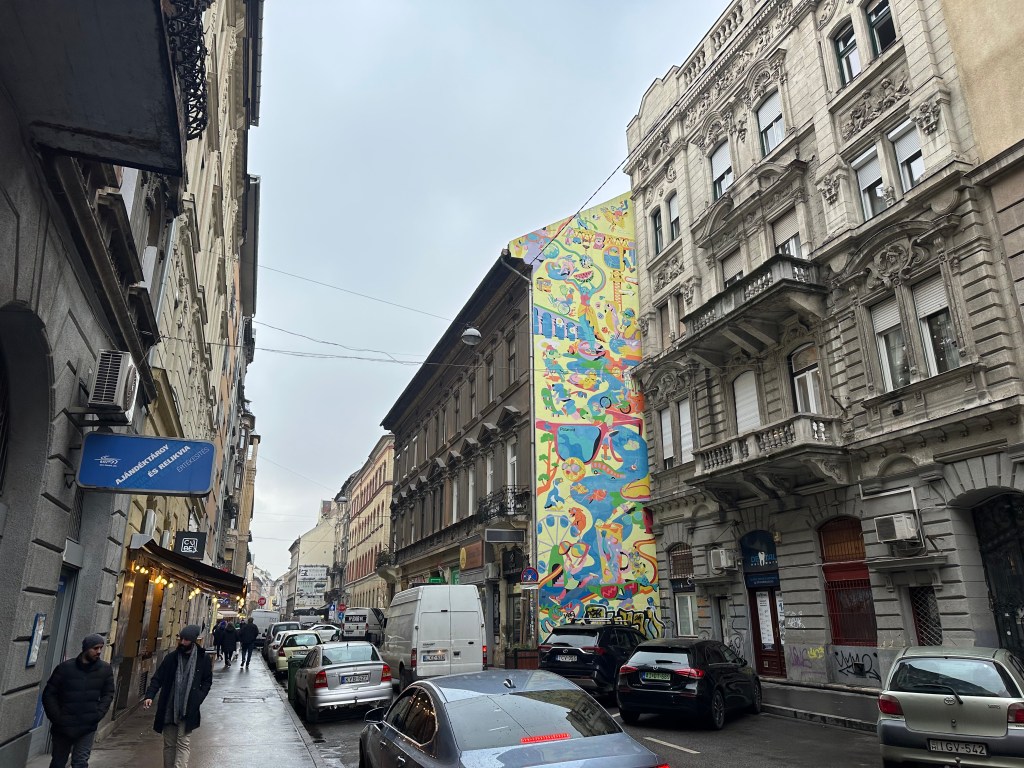
As it got a little closer to our departure time, we headed back to the T62 Hotel, collected our bags, and began the walk back to Keleti Station, which by this time of night, was lit up fabulously!
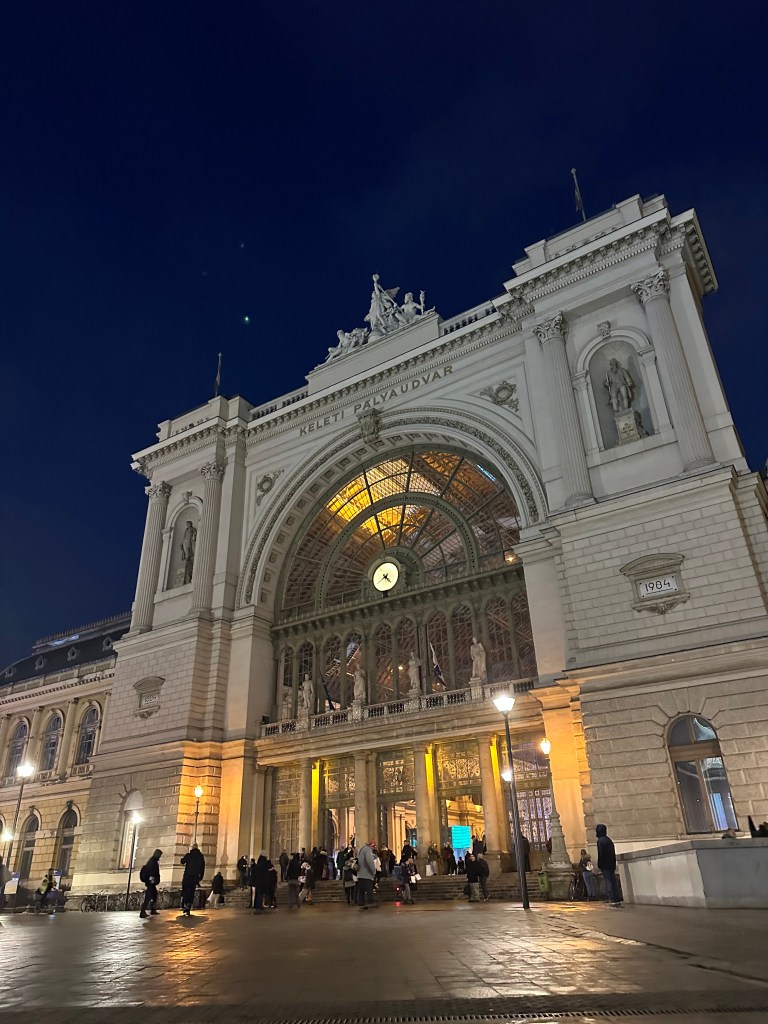
Budapest Keleti Station at night
Thanks to our sleeper-cabin booking on our overnight train, we were able to access the VIP lounge at Keleti Station – it’s actually quite handy, as you’ve got access to free soft drinks, tea and coffee, as well as various snacks – and it’s a comfortable place to sit and wait for your train. We’d already eaten (at the Middle Eastern canteen next to T62 – very filling, and very cheap!), but we did manage to squeeze in a coffee and a hot chocolate!

Hungarian Railways Lounge at Keleti Station
Eventually, our train arrived, and we headed over to the platform. Our time in Budapest was over, but awaiting us was an overnight journey into the heart of Romania!
 Global Wanderer
Leave a comment