


5/7/2023 – 7/7/2023
Today marks our first day of driving across the Iranian countryside – heading towards Yazd, via the ruins of the ancient city of Persepolis. An early start was necessary, for driving time, but more importantly, for beating the heat at Persepolis, which would peak in the early afternoon. Iranian desert heat is bearable, because it is so dry, but it isn’t exactly pleasant to be stood out in the open in the middle of the desert when it is 44º.
After about an hour of driving, we pulled into the almost-empty carpark a short walk from the entrance to Persepolis. Some issues were had in regard to buying a ticket – there are automated machines in a small ticket office, but they only take Iranian cards, no cash – and it took a few minutes to locate someone to relieve us of some cash in return for entrance tickets. Finally, we were walking up the enormous stairway, and through the giant pillars that marked the entrance to the city.
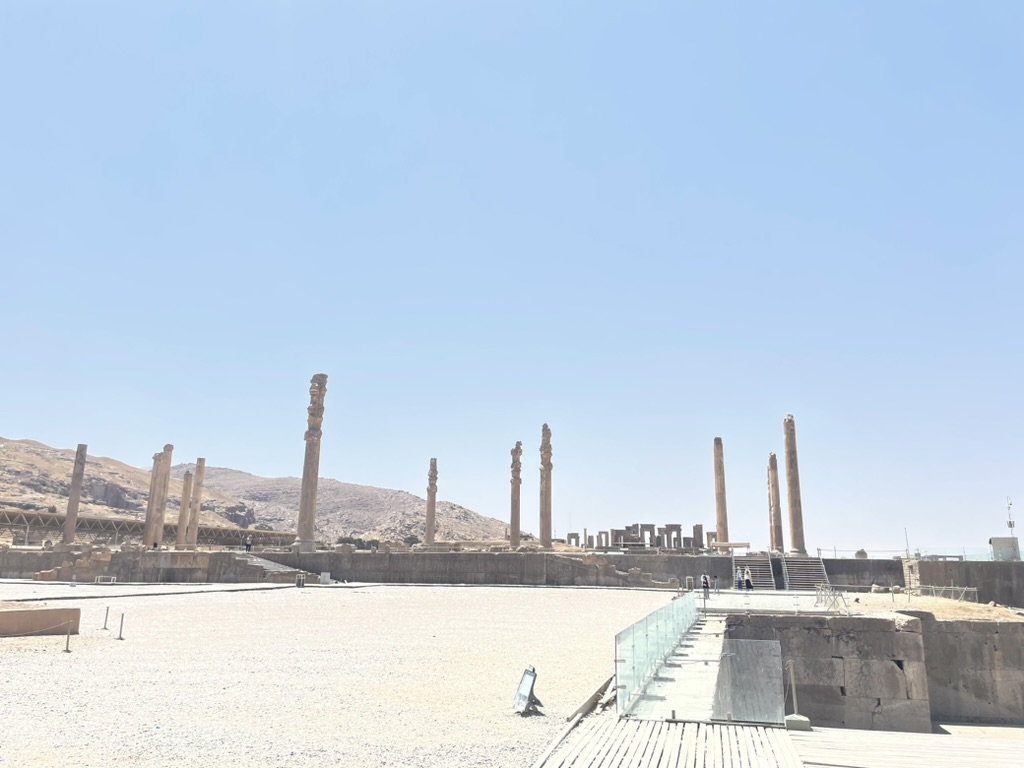
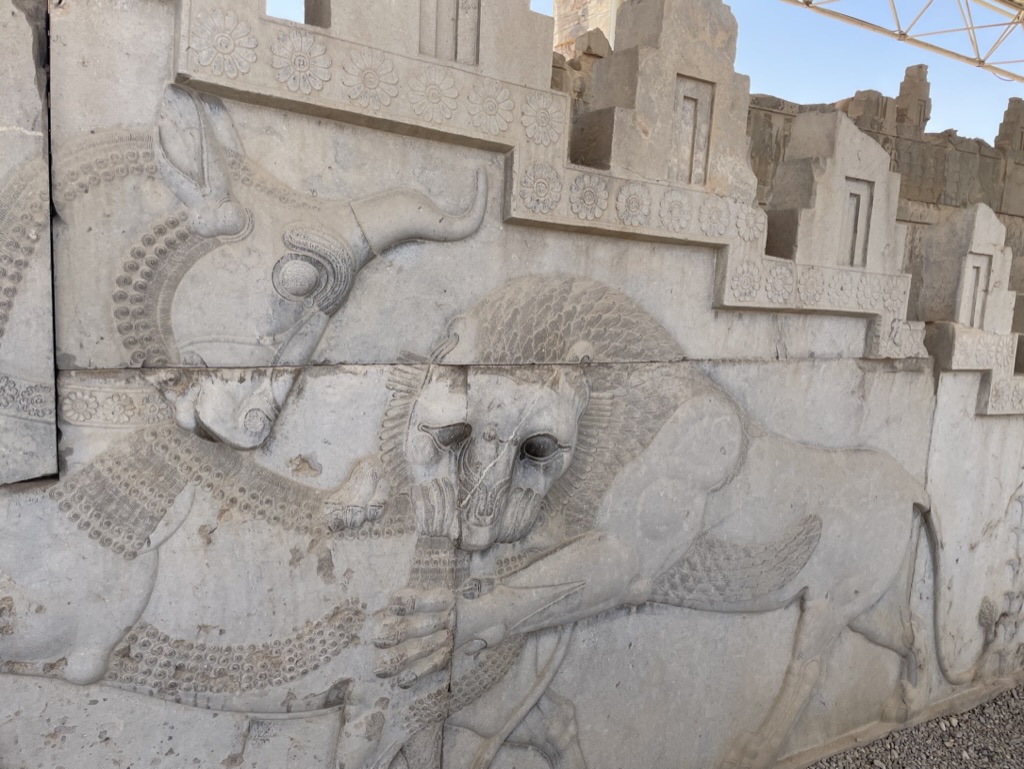
Persepolis was destroyed in a fire set by Alexander the Great during his conquest of Persia, and whilst the city was destroyed, much of the ruins are accessible and in good condition. Engravings on the walls and bas-reliefs are preserved in great detail, and there are amazing views across the desert. I’d say we spent a good 90 minutes exploring the complex – which wasn’t nearly enough, but the heat was getting oppressive! Whilst Kharoush took us around, we were asked by a young Iranian couple (from Tabriz) if they could tag along with us and listen in! It was amazing to see that Iranians too, come to visit Persepolis.




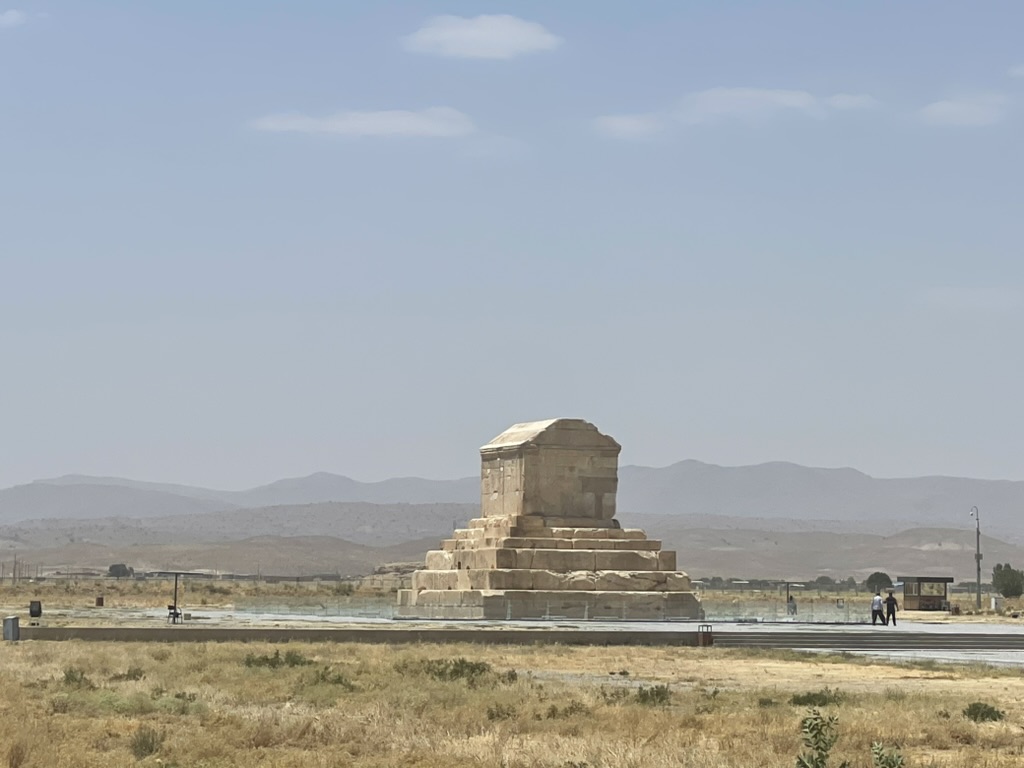
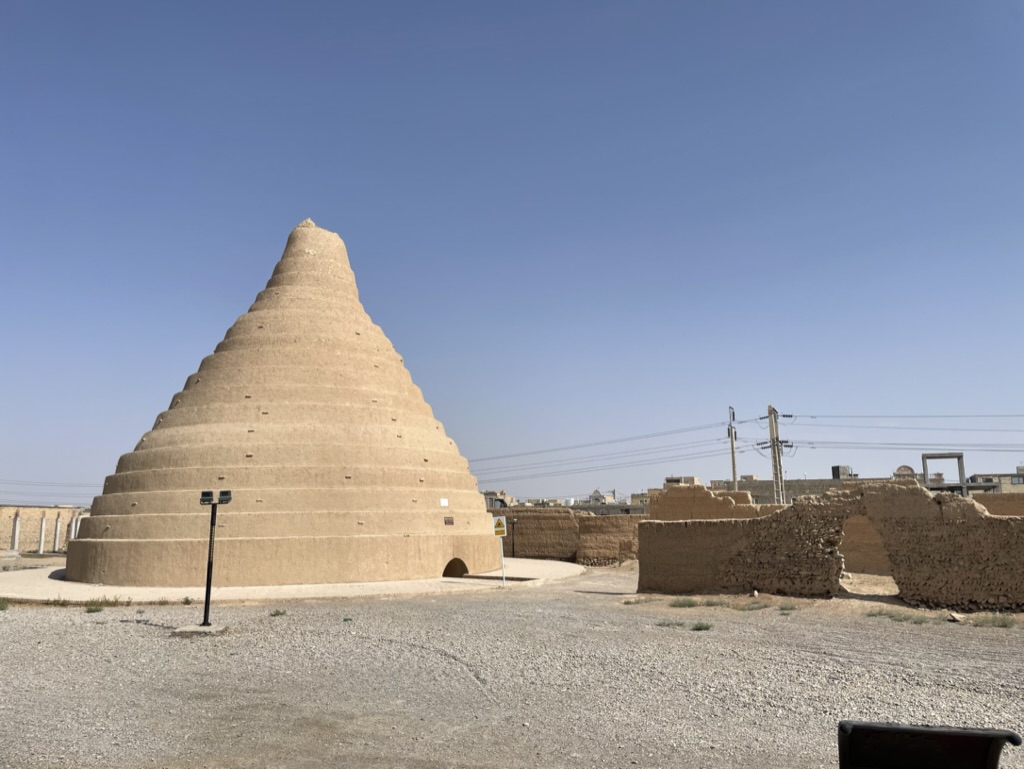
Next up on our route to Yazd was the tomb of Cyrus the Great, Pasargadae. The tomb itself is not exactly the most remarkable thing in the world, but Cyrus is considered the founder of Persia, and Iranians feel a pretty clear sense of pride about his accomplishments. We stopped in a carpark by the side of the tomb, so that we could see it without going inside and paying the entrance fee (not a huge amount of money, but there wasn’t too much point as you couldn’t get much closer to the tomb anyway!). One of the most fascinating things so far about this drive has been the changes in the landscape – every 50 or so kilometres the landscape looks entirely different! The last stop before the long stretch of driving was unplanned – but we decided to take a look at the icehouse in Abarkuh. These adobe buildings, that look like upside-down clay pots, were where cold water and products were stored during summer months. In the winter, a pool of water in front of the icehouse would be frozen and cut into blocks, which would then be moved into the icehouse.


Before reaching Yazd, Kharoush took us off-road to get a first-hand look at the ancient qanat system, which funnelled water from wells and springs to the towns. The qanats were dug by hand, and every so often had an air-hole coming up to the surface so that workers could breathe and enter/exit the tunnels. Once you know what they look like, you begin to spot them everywhere as you get closer to townships!
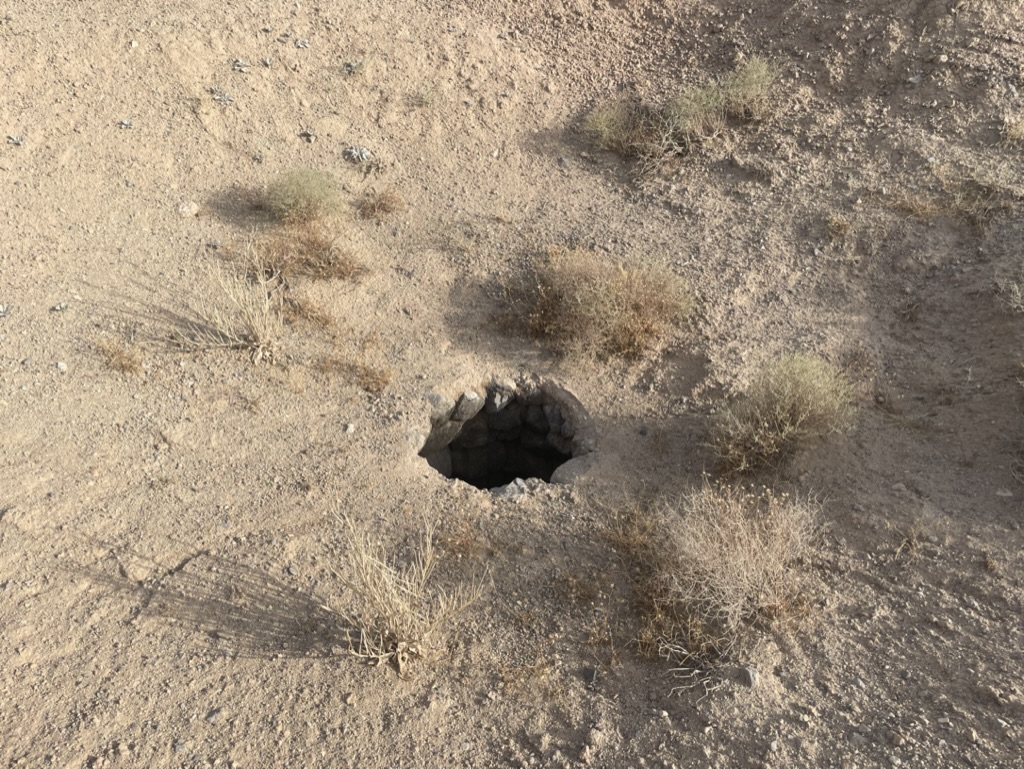
One of the qanat-related holes.
Finally, we pulled into Yazd. We’d been told that our accommodation had been shifted to a newly-opened hotel, Ketrova, which had been built in an large old property in the centre of Yazd. This was by far the best place we stayed in Iran – the rooms were stunning, and the hotel (not that you can really call it a hotel in the traditional sense, it still very much seemed like a house!) was amazing.

The courtyard at Ketrova.
Before calling it a night, we decided to go for a bit of exploration, walking through Amir Chakhmaq square at night, and heading towards the Friday Mosque. Yazd is a very pretty city, full of old adobe houses and tiny pathways you could get lost in, and is super vibrant, despite being one of Iran’s more conservative cities. After walking past an impressively-lit up mosque, and a large clocktower, we finally found ourselves at Yazd’s Friday mosque. This particular mosque has the tallest minarets in Iran, but what was more interesting was a performance which was happening out the front of the mosque, a religious one that we assumed was related to the recent Eid, but which featured a guy getting up and singing ‘Gangnam Style.’ One of the strangest things that I’ve ever seen, that is for sure!


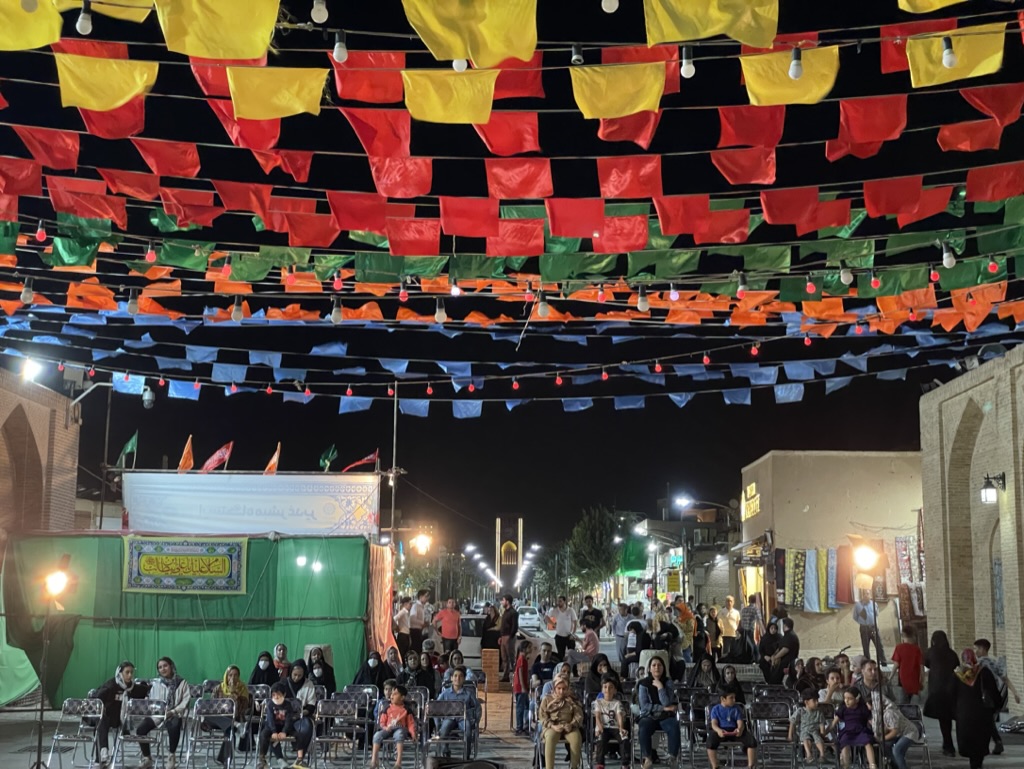
At this point, we were getting hungry, having been on the road all day, and decided to visit a café called Nardoon, located on the rooftop of one of the old buildings in Yazd. The views over the city were amazing, and we decided that we’d come back the next night to watch the sunset. After a meal of dopiazeh and something eggplant-y that I can no longer recall the name of, and persuading the house cat not to eat our food, we headed off back to Ketrova for some sleep!

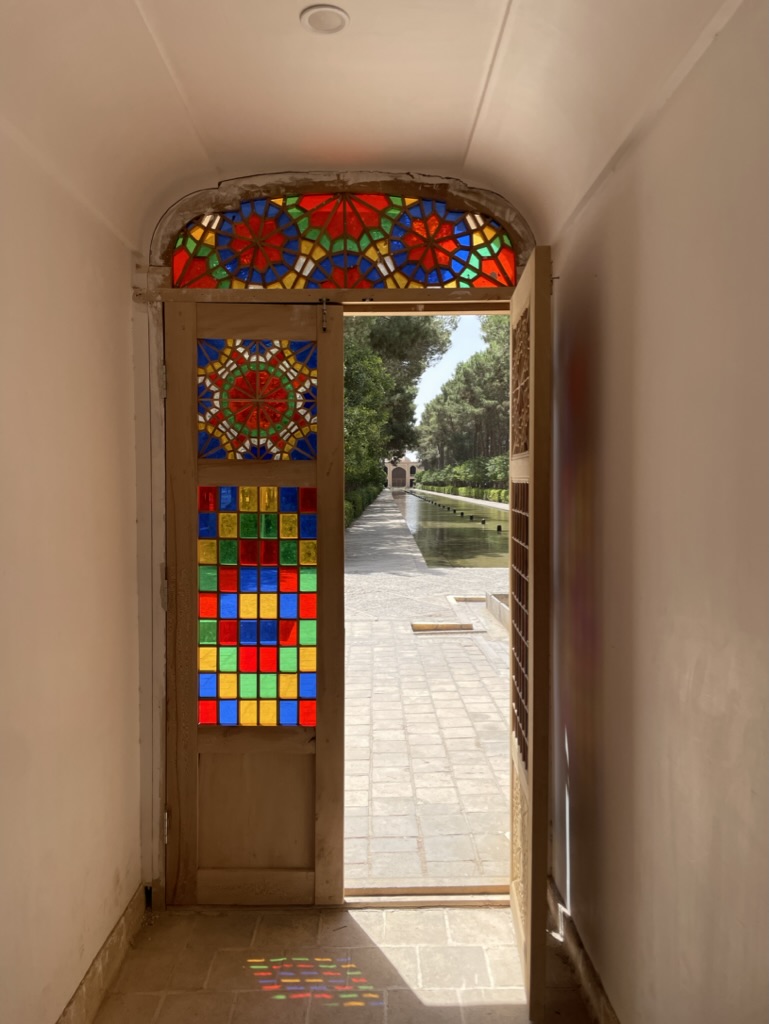
Following an egg-heavy breakfast (the guys at Ketrova kept wanting to feed us more!), we headed off to the Dowlatabad Gardens. Giant cypress trees surrounded the empty canals, and the pavilions in the gardens were in need of some TLC… but there was still beauty to be found here, with amazing stained glass windows, some interesting plant-life, and the gigantic wind tower at the centre of the garden.


Still, we were ready to move on pretty soon, and hopped into the car, driving towards the base of the hill in Yazd that houses two Zoroastrian Towers of Silence (known as dakmehs). These were used right up until about 60 years ago for the disposal of Zoroastrian dead – burying them would result in the ground becoming impure, and using fire to cremate them was considered sacrilegious, as fire plays a central role in the Zoroastrian faith. So, they decided to create walled buildings at the tops of hills to leave their dead to be cleaned up by vultures. Yazd has a couple of these dakmehs, and so we began our walk up the hill to reach the nearest one.
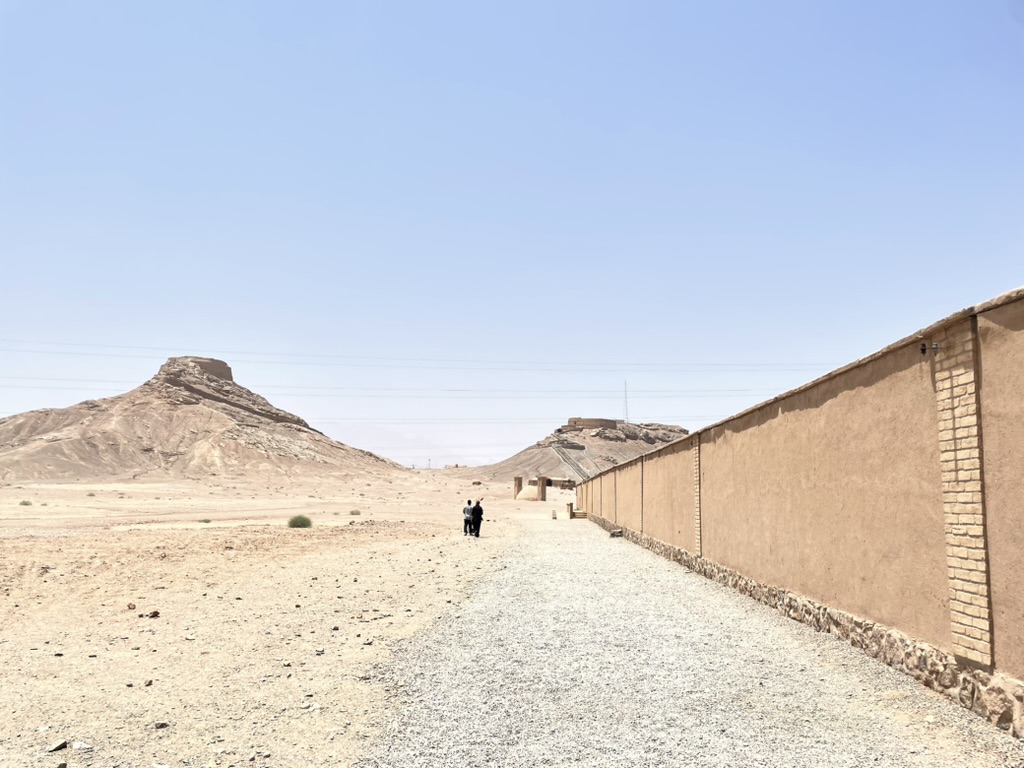
At the base of these dakmehs, clay/adobe houses were built in order to house relatives of the deceased. As there weren’t dakmehs everywhere, people within the nearby region travelled in order to pass on their deceased relatives – and obviously needed somewhere to stay whilst they waited for the ceremonies and whatnot to be complete. These houses are obviously in ruins now, but walking through them was an incredibly interesting experience.


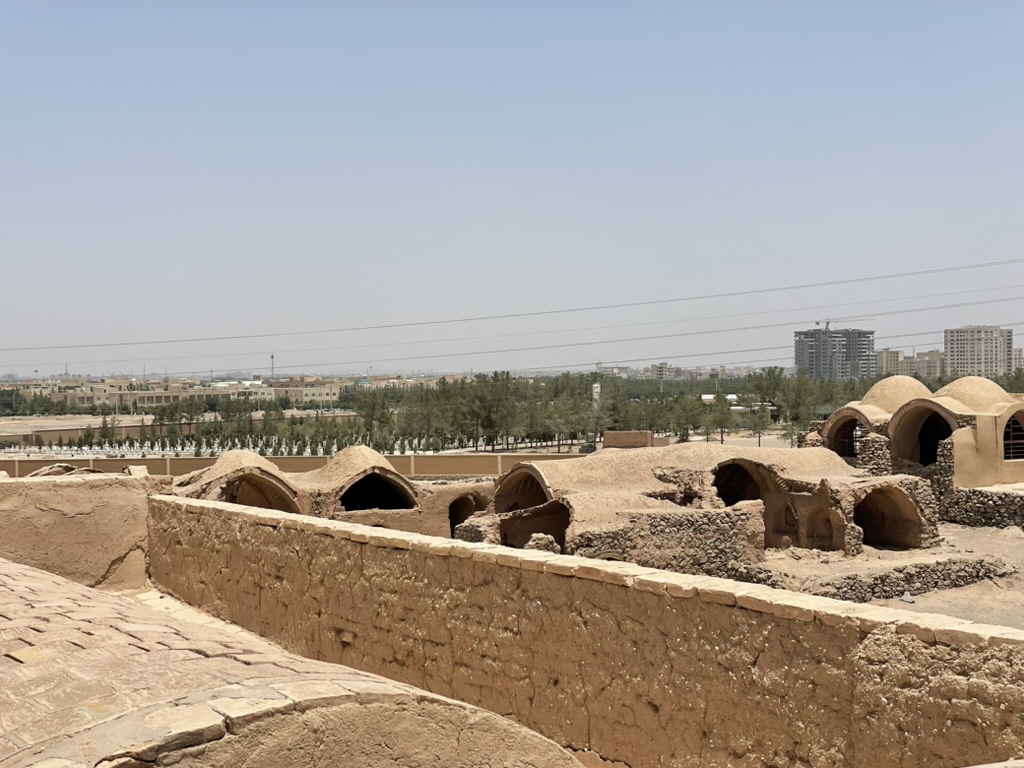
Finally, we reached the dakmeh at the top of the hill. The views across the countryside are absolutely incredible here, and it was well worth the walk up. In the centre of the dakmeh is a large well, where bones and whatnot were placed. It’s amazing to think how recently these were used as a form of ‘burial’. From the top of the dakmeh, you can actually look across and see the new Zoroastrian cemetery – I believe they create holes filled with cement so that the bodies are not technically touching the ‘earth’.
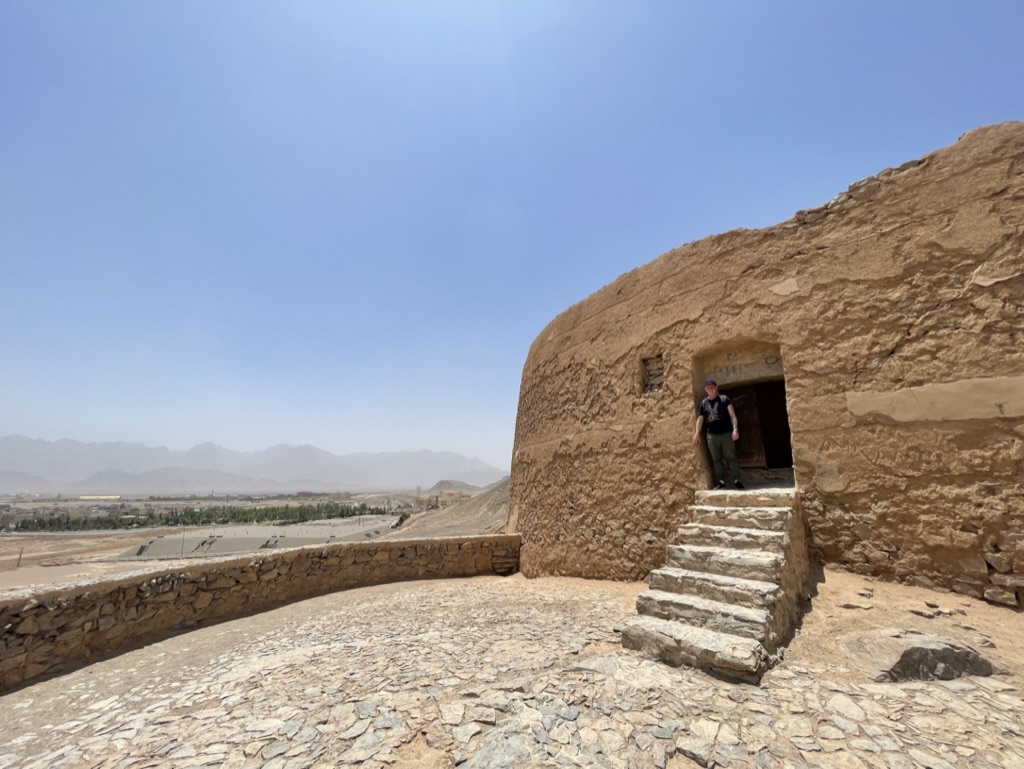

Dad at the entrance to the dakmeh, and the view over Yazd and the surrounding countryside.
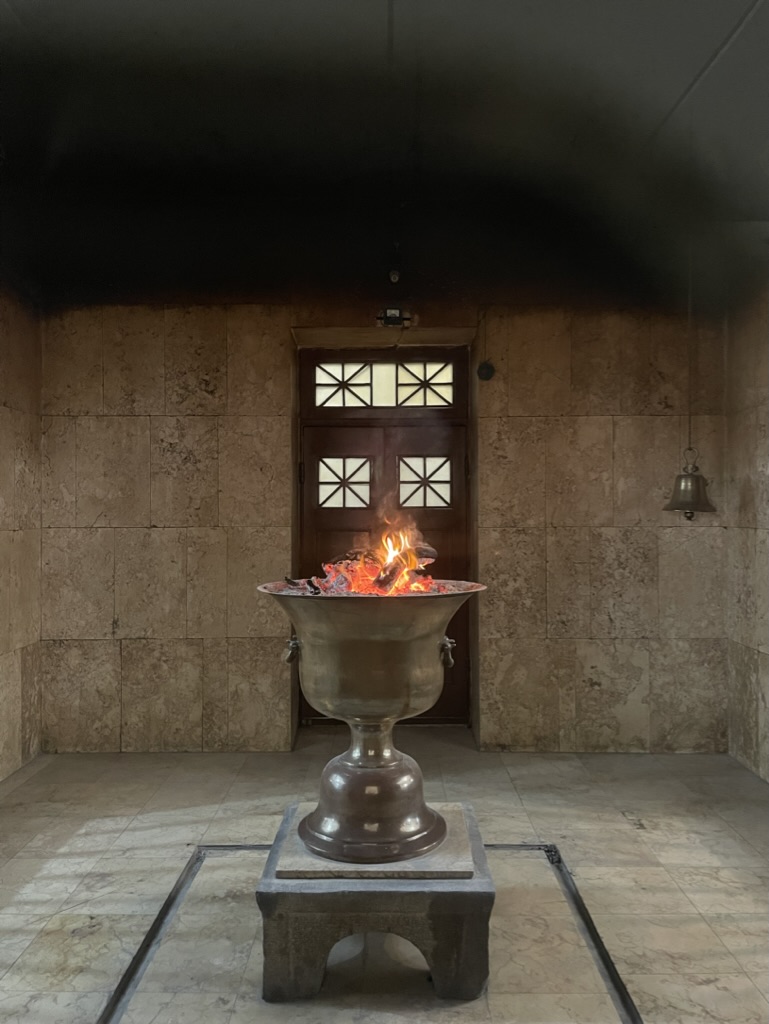
After finally getting down the hill (we admired the views for a bit!), we decided to continue in the Zoroastrian vein and head to the still-active Zoroastrian fire temple in Yazd, known as Atashkadeh – which is essentially their version of a church/mosque/synagogue/temple. Inside the temple was a giant picture of their god, Zoroaster, who bears an uncanny resemblance to Western imagery of the Christian/Jewish god… lots of similarities! Zoroastrianism is actually one of the oldest monotheistic faiths, predating all of the Abrahamic ones! Worship centres around the miracle of fire, and at the centre of the temple sits a large fire burning in an urn that I’m led to believe has been burning consistently for at least a few hundred years. There were lots of informative plaques explaining aspects of the faith, which originated in Persia and still retains an official status in the Islamic Republic, with one member of the parliament being elected specifically to represent those of the Zoroastrian faith.
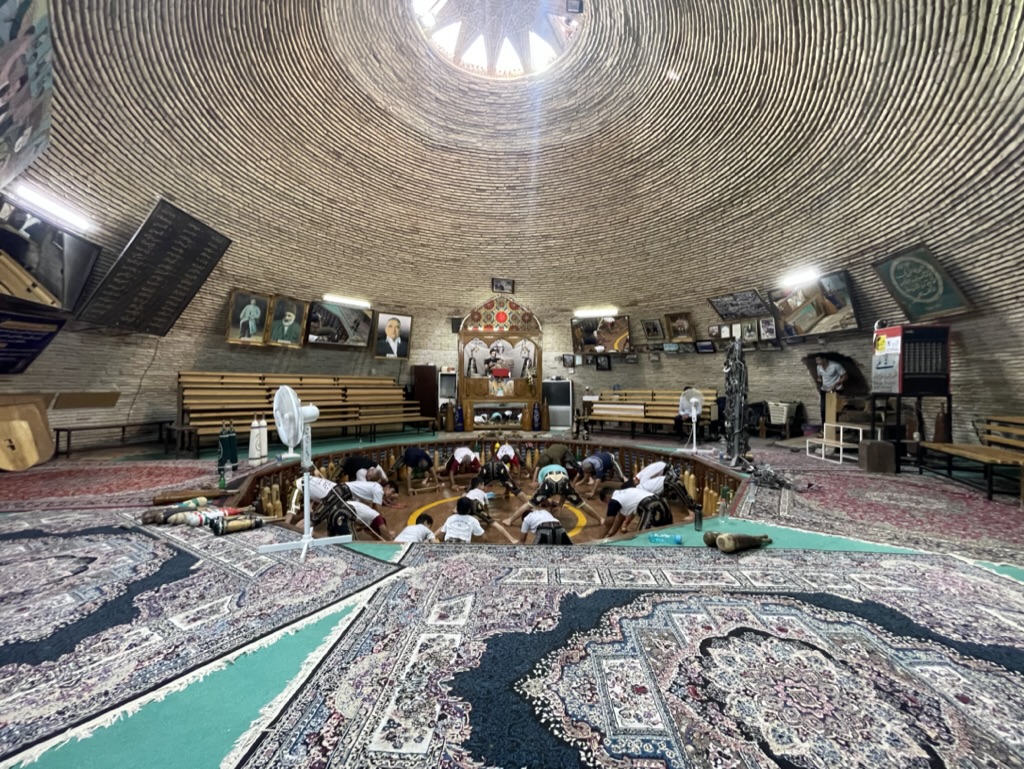
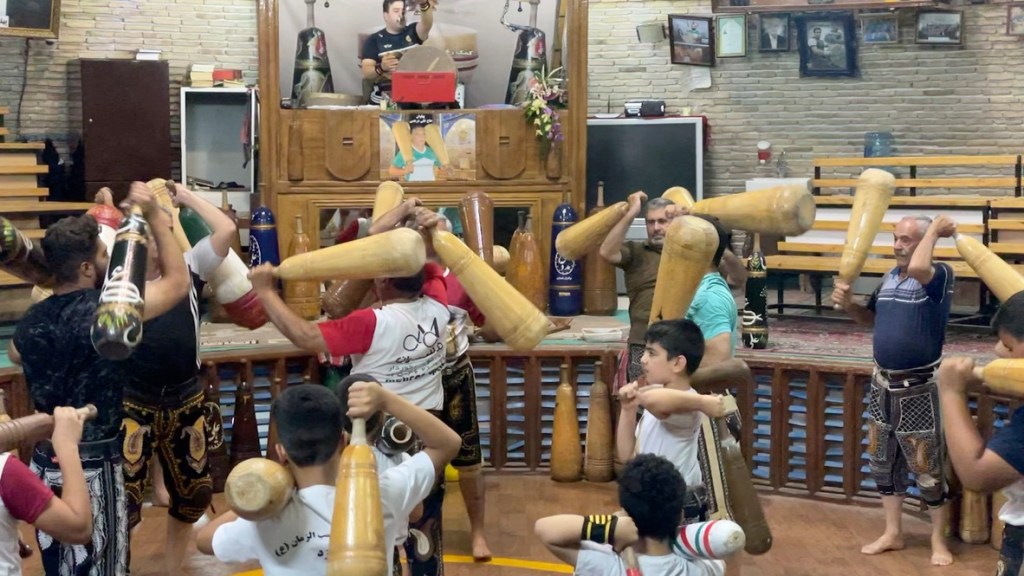
We headed back to Ketrova for a bit of a rest before heading out again for one of the most interesting things we saw on our trip – a Zurkhaneh performance! This is a type of Persian exercise involving spinning and swinging hefty weights, and it is performed by young boys all the way up to old men. We’d seen a few of these performances on documentaries about travel in Iran (Levinson Wood and Joanna Lumley), and we ended up at the same zurkhaneh location, an underground room built on top of an ancient water reservoir. The performance itself lasted almost an hour, and is centred around the men in the ‘pit’ following along to religious music being performed by a musician on top of the ‘pit’, It is hard to explain exactly what goes on in the performance itself, but there is a lot of whirling! It was very impressive to watch, and once they’d finished up (and provided everyone watching, mostly family members, with juice and cake), we were invited to pick up the weights they had been waving over their shoulders – not exactly light!

We headed back to the rooftop café we ate at the previous night for a coffee, and to watch the sunset. I set my phone up against a stone and left it recording a timelapse of the sunset, whilst we sat and watched the city of Yazd turn a beautiful golden colour as the sun dipped behind the horizon. It really is a beautiful city! Finally, we began our walk back to the hotel, not before stopping to kick a football around with a young boy in one of the small squares dotted around the city. Moments like this whilst you’re travelling are honestly my favourite – you can see as many cities, sites, or museums as you want, but being a part of local life for a few seconds and seeing other another person’s world is what it’s really all about!


An evening in Yazd.


 Global Wanderer
Leave a comment