

22/6/2022 – 26/6/2022
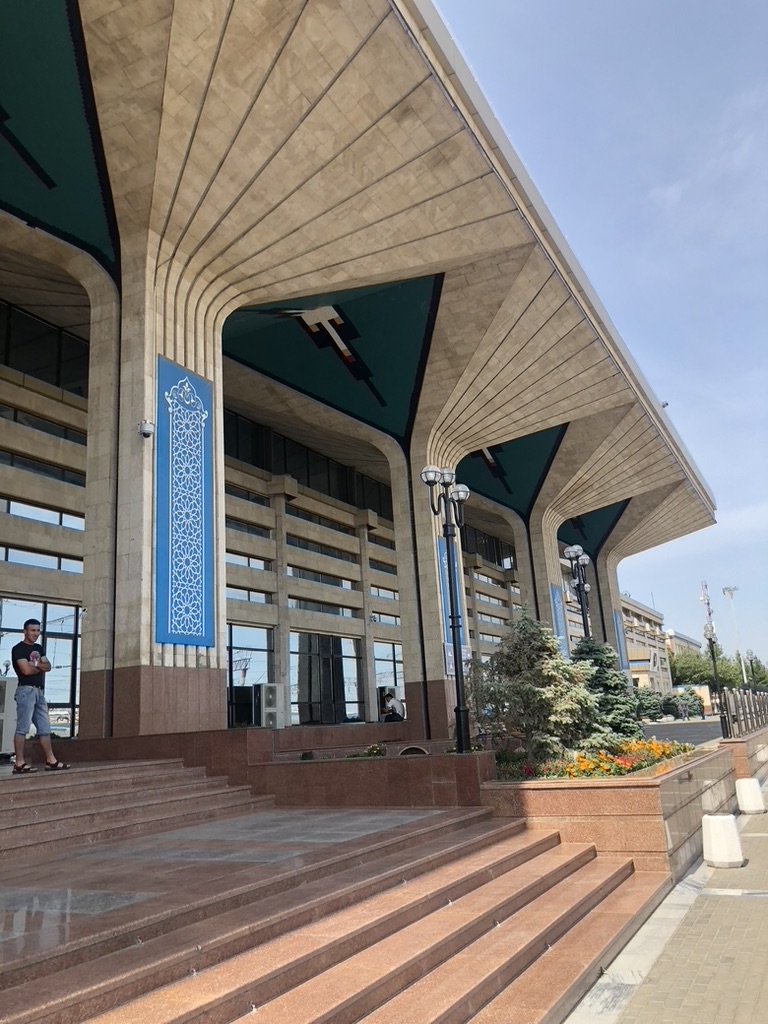
This morning, I woke up early, gathered my things, woke up the hotel manager (who was asleep on the couch by his desk!) and checked out. Whilst waiting for a Yandex I had ordered to the train station – you absolutely need this app on your phone if you’re travelling in Uzbekistan, I promise you – an old lady approached me and asked in hesitant Russian where I was going. I explained that I was going to the train station which must have been somewhere near where she wished to go, because she gestured towards the Yandex, asking if she could share. Unfortunately for me, our wires had gotten crossed somewhere, and she wanted dropping close to the SOUTHERN Tashkent station, as opposed to the central/northern one which I was leaving from. Huge tip in Tashkent – make sure you know which railway station you are leaving from! After trying to explain for a few minutes to the driver in my broken Russian that I didn’t want the southern station, but the other station, he finally got the message, and drove me up the street to the northern station. I expected a higher fare, but the beauty of the Yandex app is that the cash fare is displayed in advance, so you pay nothing more than that. After going through the obligatory bag scanner and ticket/passport check, I entered the train station, and waited on the platform to board the high-speed Afrosiyob train to Samarkand.

The Afrosiyob is a high-speed Talgo train that runs between Tashkent, Samarkand and Bukhara. It is slightly more expensive than the older Sharq trains, but honestly worth it in my opinion. It is probably a good idea to book in advance (the UzRailways site worked well for me), as the Afrosiyob is very popular with locals and tourists alike, and tends to fill up quickly – every seat was taken on my train as far as I could tell. There’s 3 classes – standard, business, and VIP. Given that VIP class worked out to under $20AUD when I booked, I decided to treat myself for the hour and a half ride to Samarkand. Similarly to a plane trip, you get given a small box of food/pastries and tea or coffee during the journey, which was helpful given I had managed to eat all of my bread before I had even boarded the train! Soon enough, the train began slowing down, and the intercom voice announced that we were pulling in to Samarkand!
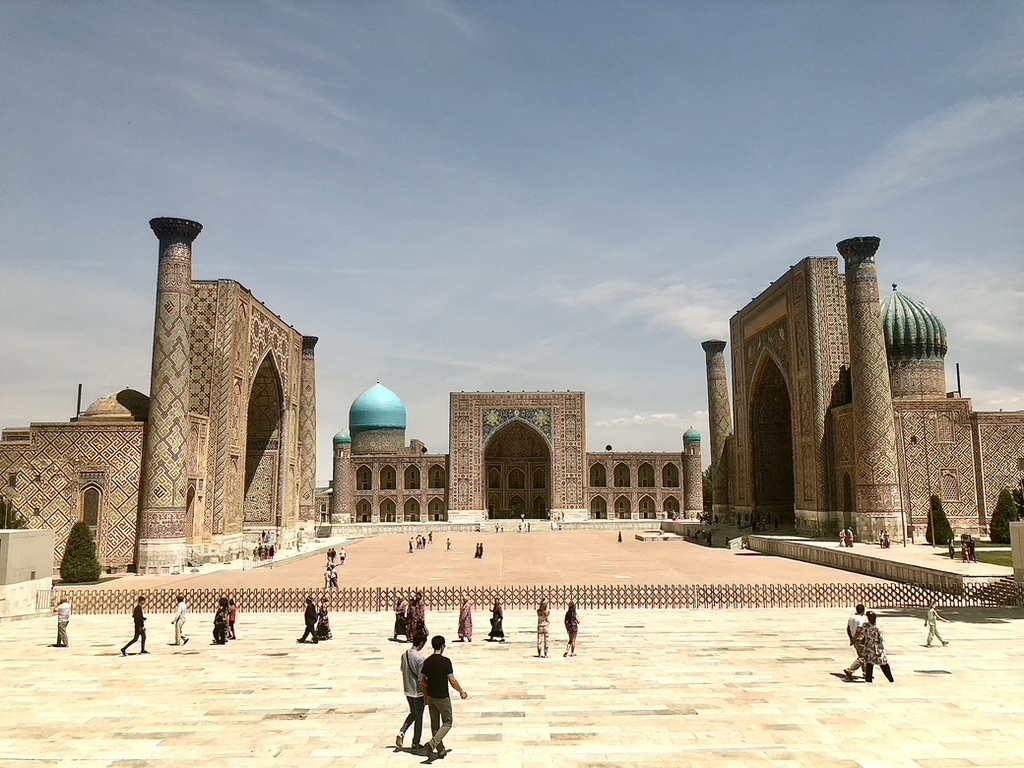
I made my way through the ubiquitous crowds of taxi drivers at the entrance to the station to get to my Yandex (again, this app is a lifesaver!). As we made our way to the guesthouse I was staying in, the driver explained to me that Samarkand and Bukhara were both ethnically Tajik-majority cities, and therefore most people spoke Tajik as their first language. The few words of Tajik that he taught me were incredibly valuable, as I found in Samarkand and Bukhara that even the use of a simple Tajik phrase was often enough to bring a smile to someone’s face. Finally, the driver pulled down a narrow side street, and explained that he couldn’t drive any further, but that the place I was looking for was about 50m ahead on the right. I paid the 20,000 som ($2.70) fare, and walked over to the guesthouse, where I was shown my room, and offered a late breakfast, which I gladly accepted. I then left my bag in my room, and decided to take a wander to the Registan ensemble, around 2 minutes walk away. When I finally got to it, I was completely blown away by the scale of the place, and spent some time taking it all in.

I then continued walking north until I made it to the Bibi-Khanym mosque. This towering building was built over 600 years ago, but its poor construction led it to fall into ruin. During the Soviet era, the government made a concerted effort to restore the magnificent mosque, work which is still underway as of the present day. The standard 30,000 som ($4) admission fee applied, which I gladly paid, and spent around an hour wandering through the courtyard of the mosque, and studying the intricate details on the structure itself.

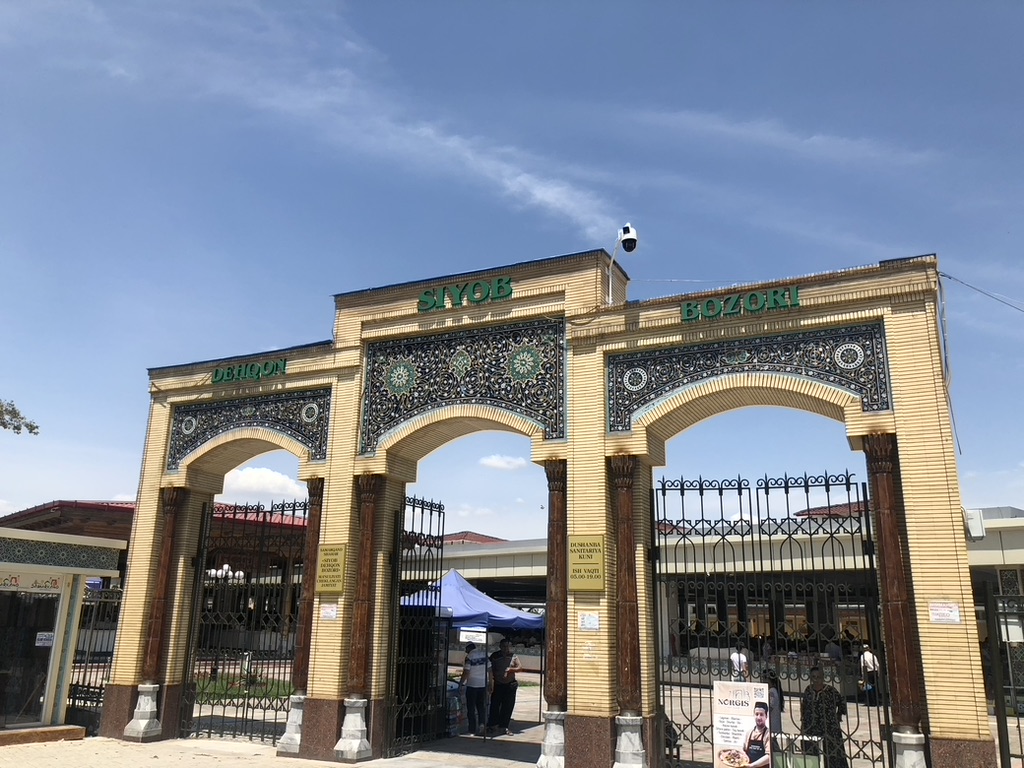
Right next door to Bibi-Khanym is the heaving Siyob Bazaar. I headed in here and wandered around for about 30 minutes before giving in to hunger and deciding to find something to eat. Around the corner from the bazaar was a small shop with a large shashlik grill out the front. I decided to stop there, and found myself eating chicken and potato shashlik, served with onions and chilli, washed down with some kind of homemade juice, the fruit of which I couldn’t quite figure out. The whole meal cost about 36,000 som ($4.10), which was an absolute bargain, considering that I walked away feeling incredibly full! Feeling utterly exhausted at this point, I headed back to my accommodation for some much needed rest!
The next morning, I woke up, and was fed a giant breakfast by the guesthouse owners, consisting of fruit, pastries, coffee, and some sweet rice dish that I would happily describe as ‘breakfast plov’. I then decided to make the hour and a half trek north to the Ulugbek Observatory, as my knee was finally feeling up to scratch. The walk north took me past the Hazrat Khizr mosque, which is situated on a hill just north of the Siyob Bazaar. The views from this hill are amazing, as you can see right across Samarkand, taking in the beautiful coloured domes from all of the mosques and madrassahs. I then continued on, past the ancient Afrosiyob settlement, until I finally made it to the Ulugbek Observatory. Mirzo Ulugbek, a grandson of Amir Timur, was a famous Uzbek astronomer, who, in an era before telescopes, understood that narrowing a bean of light made the focus clearer. He built a large observatory, and calculated the length of an Earth year to within one minute of the current scientific calculations. The Observatory, which cost – yep, you guessed it – 30,000 som ($4 – the exchange rate kept shifting a little as I travelled, so I’m trying to peg it as it was each day!) – consists of a small museum with artefacts and information about Ulugbek, and a part of the observatory where you can peer down the light-focussing tunnel.

Making my way southwards, I decided to stop into the Afrosiyob settlement’s museum, where ancient wall paintings were displayed alongside ancient artefacts from the Sogdian Empire. This was actually really interesting, as it covered a slice of ancient history, far removed from the mosques and minarets of the Temurid era.

My next stop was the impressive Shah-i-Zinda necropolis. Instead of walking all the way down the hill to be faced with crowds and entrance fees, I decided to follow some advice I had read online, and walked through the cemetery bordering the site. This was interesting in itself: some gravestones dated back to the 1920s; others were decorated with the Communist red star. Finally, I saw the blue domes of the Shah-i-Zinda site, and hopped the (waist high) fence around it.

I found myself at the back of the avenue, facing down towards all of the blue hued mausoleums. I spent about an hour exploring the ins and outs of almost all of the mausoleums, marvelling at the way the blue tiles seemed to shimmer in the sunlight. It was by far one of the most impressive things I have ever seen!

Once I had left Shah-i-Zinda, I decided to head back to the guesthouse to beat the late afternoon heat, and so that I had enough energy to visit the Registan after sunset for the light show. When I finally left, it was 8:30pm, still not dark, and 38ºC – but that’s Uzbek summer for you! I decided to walk south in the direction of the Gur-e-Amir mausoleum whilst waiting for the sun to properly go down, where I stopped off along the way to eat some bread, tomatoes and onion from a street-food vendor. In the end, nightfall came before I had reached Gur-e-Amir, so I headed back towards the Registan, where the lights turned to fabulous colours at 9pm. My final job before going to bed was to sort out the large wad of cash that no longer fit in my wallet – whilst higher denomination bills have eased this significantly in recent years, I guarantee you will STILL end up with way too many paper bills!

For my final day in Samarkand, I had two simple plans – to explore the Registan complex, and to visit the Gur-e-Amir mausoleum. I decided to tackle the closer of the two first, so I headed over to the Registan, where I paid 50,000 som ($5.50) for a ticket – the only time anything cost more than 30,000! What did make me happy about the ticket costs everywhere in Uzbekistan was that there was a price for foreigners, and a price for Uzbek citizens that was around 10% of the foreigner price – it’s really good that the they are at least trying to make sure that Uzbeks are able to visit the historical sites and are not priced out by tourism. The Registan complex is unbelievably huge, so I decided I would explore the insides of the madrassahs in a clockwise direction to give some order to it. Each interior had a segment dedicated as a kind of museum, explaining the history of the building, and providing contextual information and artefacts relating to life in the madrassahs, as well as photographs of the buildings over the last century. The former student cells in the madrassahs are now populated by small souvenir shops, where sellers will happily explain about topics ranging from carpet and silk production to the history of the madrassah. I spent almost 2 hours wandering through the complex, thoroughly enjoying the self-guided, walk-through, history lesson!

I then made my way to the Gur-e-Amir mausoleum, the final resting place of the infamous Amir Timur. The dome on the top of his mausoleum was undergoing some restoration on the exterior, but luckily for me, it did not at all affect the interior of the building. Decorated in gold, Amir Timur’s tomb was one of the most dazzling things I have ever seen. A young Uzbek guide wanting to practice his English asked if he could show me around – for free – and so I got an in-depth tour of the mausoleum, and the history of Amir Timur. After spending some time walking through the grounds, I decided to head to the busy strip of restaurants and shops opposite the Registan for a plate of kavurma laghman (fried laghman noodles), before walking to the guesthouse to make sure that I was ready to leave for Bukhara the next morning!


 Global Wanderer
Leave a comment